LOCAL VISIBILITY INSIGHTS
DOES ADVERTISING IN WAITING ROOMS WORK?
It can create scheduled opportunities for a local message to appear during a visit. The useful question is what the schedule can show, and what it cannot.
4 minute read
START WITH THE VISIT, NOT A PROMISE.
Waiting rooms are different from many fast-moving public environments. A person has arrived for care, is waiting for the next step, and may be in the room long enough for a scheduled screen loop to return.
That makes waiting-room advertising useful as a local visibility channel when the venue, advertiser category, and screen schedule are a fit. It does not make attention automatic. Presence in a room does not prove that someone looked at the screen or noticed a specific ad.
A LIVE DDM WAITING-ROOM EXAMPLE
Pulse Urgent Care & Vein Center is a live DDM venue partner. Its installed screen gives advertisers a real local waiting-room environment to consider when planning selected-screen placement.
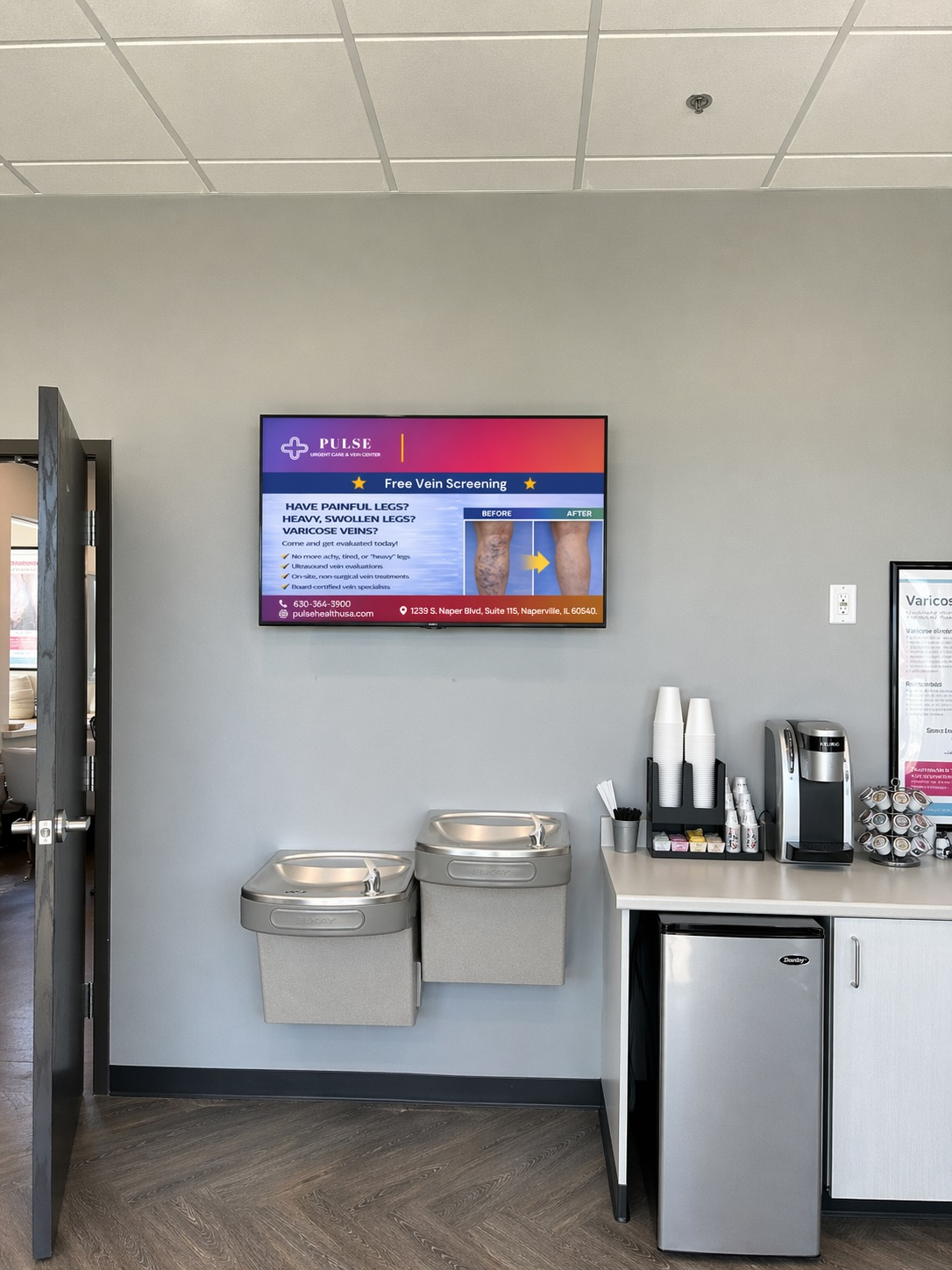
For planning context, an estimated visit at Pulse Urgent Care & Vein Center is approximately 15 to 30 minutes. The public DDM schedule is a 15-minute loop. That means a visitor may be present for roughly one to two loop rotations during that estimated visit window.
This describes scheduled loop opportunities during an estimated visit window. It does not measure whether an individual visitor looked at the screen.
That arithmetic explains the opportunity, not an outcome. A person may be present while the loop returns once or twice. It does not establish that person's attention, recall, or response to a campaign.
Screen and category availability are confirmed individually. A venue's presence in the DDM network does not imply availability for every advertiser category.
THE SAME LOOP CAN MEAN DIFFERENT THINGS.
Venue context changes the time available for a visitor to be present. The comparison below uses estimated visit windows to make that distinction visible. It is planning context, not a count of views or attention.
For a closer look at the restaurant example, read how repetition builds brand trust. Different visit lengths can create different scheduled opportunities, even when the loop itself stays the same.
WHAT DDM COUNTS, AND WHAT IT MODELS
DDM can report scheduled ad plays, the selected screens that carried a campaign, and the reporting period. Those records describe the delivery schedule.
A selected DDM screen averages approximately 1,400 plays per screen per month, based on the DDM network average. Venue traffic, estimated visit duration, and modeled impressions are planning inputs. They do not prove attention from a particular person.
PLAYS ARE COUNTED. IMPRESSIONS ARE MODELED.
Learn how DDM measures delivery and explore indoor billboard advertising for a fuller view of the format.
THE PRACTICAL TAKEAWAY
Waiting-room advertising works best as a clear, local visibility opportunity with an understandable delivery schedule. Match the message to the venue environment, confirm availability, and assess results using the measures that can actually be reported.
LOCAL VISIBILITY
SEE WHERE YOUR BUSINESS COULD BE SEEN
Review DDM screen locations across Chicago's western suburbs and check current category availability.